
Check six points: steel alloy (nameplate or PMI test), plate thickness, heat transfer (jacket or coil), agitation and shaft sealing, motor and gearbox, and internal finish if it is sanitary. At JEMP you check all of this in the yard before closing.
6-point checklist
| # | What to check | How to check it |
|---|---|---|
| 01 | Steel alloy | Nameplate or PMI test |
| 02 | Plate thickness | Ultrasonic measurement on shell and bottom, compared with the design thickness |
| 03 | Jacket or coil | No dents, no signs of leakage between chambers, nozzles intact |
| 04 | Agitation and sealing | Straight shaft, mechanical seal or packing in good condition, bearing without play |
| 05 | Motor and gearbox | Nameplate (hp, rpm, voltage), noise, play, oil |
| 06 | Internal finish | Sanitary welds and polish, no pitting |
Before going to the yard
- Working volume and temperature of your process.
- Operating pressure and vacuum, to compare with the nameplate.
- Product viscosity, which determines the agitator.
Pressure equipment
A jacketed reactor or one that operates under pressure is usually a pressure vessel and falls under NR-13. See what NR-13 requires to put a used unit into operation.
In stock now
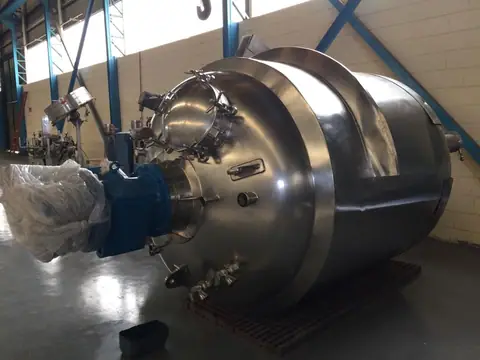
RE0830 · Stainless steel 316L reactor, 3,500 L, sanitary
316L stainless steel reactor, 3,500 liters, sanitary finish, with half-pipe coil, insulation, electric heating element on the bottom and anchor agitator.
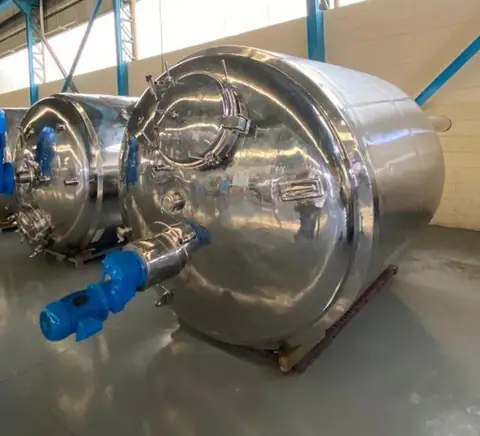
RE0832 · Stainless steel 316L reactor, 5,830 L, sanitary
316L stainless steel reactor, 5,830 liters, sanitary finish, with half-pipe coil, thermal insulation, off-center agitator and spray ball.
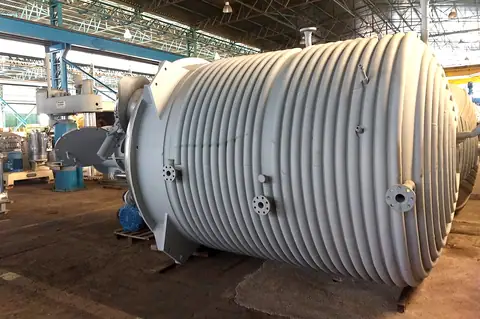
RE0287 · Stainless steel 316 reactor, 12,000 L
12,000 liter 316 stainless steel reactor, with three-stage half-pipe coil and turbine agitator with paddles.